

Centralized Vacuum Solutions Enable Significant Energy Savings Across Industrial Operations
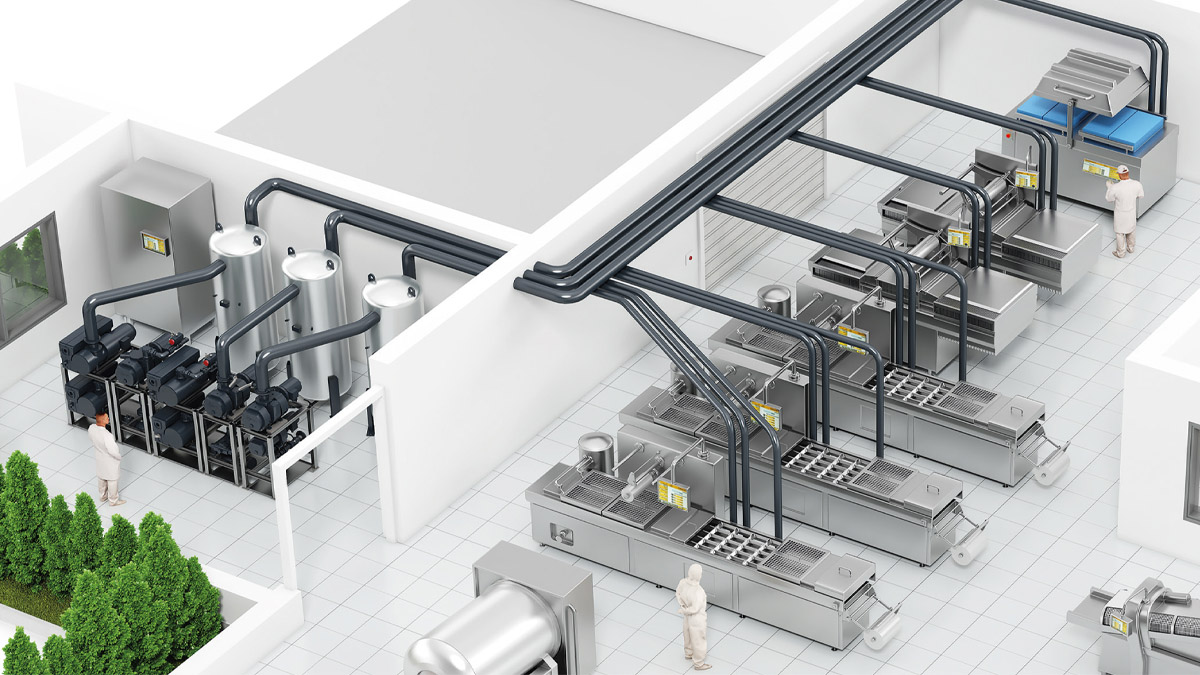
Central vacuum system with multiple vacuum pumps and receivers supplying several production machines via a common piping network. Image source: Busch Group.
MAULBURG, GERMANY, July 10, 2026 /EINPresswire.com/ -- When it comes to industrial vacuum systems, efficiency is not just determined by the vacuum pump you choose. It is also shaped by how vacuum supply is configured. This configuration defines how vacuum is generated, distributed, and matched to the actual requirements of the application. One of the most impactful changes a facility can make is to move from a decentral to a central vacuum supply.
In many applications – particularly those involving multiple machines with intermittent or cyclic demand – a central vacuum system can reduce energy consumption by up to 70%, while also improving process reliability, maintainability, and working conditions.
This article explores the core differences between central and decentral vacuum systems, explains how centralization saves energy, and outlines the practical factors to consider during planning and implementation.
What is a central vacuum system?
In a central vacuum system, vacuum is generated in a dedicated plant room and distributed to multiple machines via a network of pipes. Rather than each machine having its own vacuum pump, the central system typically uses a bank of vacuum pumps controlled to match overall demand, often with built-in redundancy. This approach decouples vacuum generation from individual machines and allows the vacuum supply to be designed at system level rather than for each process.
How central vacuum systems save energy
In a decentralized setup, each machine is equipped with its own vacuum pump. These pumps typically operate at a fixed speed and are selected by machine suppliers to ensure performance under all conditions. Pumps are commonly sized for the worst-case peak vacuum demand at maximum machine speed, and to maintain machine performance even in the event of vacuum leaks. As a result, safety margins are duplicated across multiple machines, leading to systematic over dimensioning of installed pumping capacity.
By centralizing, fewer vacuum pumps are typically required to operate. This is a result of control strategy, shared capacity and reduced simultaneity between individual vacuum consumers. By designing the vacuum supply at system level, installed pumping capacity can be reduced while still meeting all process requirements.
A central vacuum supply is especially efficient in installations with cyclic processes, such as vacuum packaging or thermoforming, where vacuum is only needed for part of the cycle. In decentralized systems, each vacuum pump continues to run between cycles, using energy without doing productive work.
In a central system for cyclic vacuum applications:
• Vacuum pumps are used to evacuate a buffer tank, rather than pumping directly from the process. The buffer volume acts as a decoupling element
between vacuum generation and vacuum consumption, allowing pumps to operate against a defined volume instead of fluctuating process demand.
This means that between cycles, the vacuum pumps remain productive by maintaining vacuum in the buffer volume.
• During operation, vacuum is delivered to the machine by pressure equalization between the buffer and process. This is possible because the buffer
volume is kept at a pressure lower than that required by the process.
• Control systems adjust vacuum pump output to match real-time demand, typically leading to fewer vacuum pumps operating at one time and a
reduction in total power consumption.
This approach delivers the required vacuum when it is needed, without wasting energy between cycles. Together, these factors can contribute to savings of up to 70% in energy, significantly lower operating costs, and measurable reductions in carbon emissions.
Key benefits of central vacuum systems
1. Reduced energy use and operating costs
• Demand-driven control ensures only the vacuum pumps that are required are in operation.
• Fewer total vacuum pumps are needed due to optimized sizing and shared capacity.
• Vacuum pumps operate within their ideal efficiency range more often.
• Lower air conditioning system loads if vacuum pumps are moved out of cooled production spaces, resulting in lower energy bills.
• Easier integration of heat recovery systems, which can reclaim 50–70% of energy used.
2. Improved productivity
• Systems can be designed for shorter cycle times by ensuring vacuum is available on demand.
• Built-in redundancy allows maintenance to take place without interrupting production.
• Equal loading across multiple vacuum pumps extends equipment life.
• Systems can often be expanded or adapted as production needs evolve.
3. Better working environment
• Vacuum pumps are located away from hygienic or operator-sensitive areas.
• No vacuum pump noise in the production space.
• No hot surfaces, oil fumes, or maintenance tasks within the clean area.
• Reduced clutter, lower trip hazard, and improved space utilization.
When to consider a central vacuum supply
A central system can be particularly beneficial if any of the following apply:
• Multiple machines require vacuum.
• Processes are cyclic, with vacuum needed only part of the time.
• Vacuum pump noise, heat, or emissions are a nuisance in the production area.
• Vacuum pumps are currently located in cooled or air-conditioned environments.
• There is a desire to install a heat recovery system.
• The production site has expansion plans or frequently changing demand.
• Processes are sensitive to downtime, so the reliability of the vacuum supply is critical.
• Greater throughput or reduced cycle time is a priority.
Key components of central vacuum systems
Control systems
Central vacuum systems depend on effective controls to ensure pumping speeds meet the demand of the process. Typically, an operating pressure setpoint is selected. The control system will then start and stop vacuum pumps to ensure the desired pressure is maintained, even if the demand from the process varies. Alternatively, the system could integrate with variable speed drives to enable pumping speeds to be adjusted to suit process demand.
Pipework and buffer vessels
Correctly sized and installed pipework is essential for system performance. It is critical that pipework is designed to keep pressure drops to a minimum, keeping pipe lengths as short as possible and using swept bends rather than tight elbows to minimize turbulence. System designers should ensure that pressure drops are calculated and kept to an acceptable level, buffer vessel volumes are sufficient, and start-up evacuation time is not excessive. Pipework materials, joint types, and supports should be carefully selected to suit the process and installation environment to ensure longevity and that an appropriate level of leak tightness is achieved.
Vacuum pumps located in plant room
Vacuum pumps are typically located in a dedicated plant room. This facilitates maintenance as access is improved for oil changes, filter replacement, instrumentation calibration, valve servicing, and control system inspections. There is also typically more space for lifting and removing vacuum pumps when overhauls are required.
Bi-line and tri-line systems
Some central systems incorporate two or three vacuum lines operating at different pressures levels, ensuring that each process is supplied only with the vacuum level it actually requires. These multiple line configurations offer further advantages over single-line systems. Where booster pumps are still decentralized in a single-line system, a multi-line system allows them to also be centralized along with their backing pumps. This enables the booster pumps to gain the same benefits associated with centralizing as the backing pumps, further improving efficiency.
Summary
A central vacuum system is not a one-size-fits-all solution, but for the right applications, it can deliver substantial improvements in efficiency. By addressing over dimensioning at machine level and matching vacuum supply more closely to actual process demand, centralisation improves efficiency at its source. The resulting decrease in energy consumption of up to 70% can significantly lower operating costs and reduce carbon emissions, supporting companies in achieving their sustainability goals. Processes that are sensitive to downtime will also benefit from enhanced reliability and ease of maintenance achieved by centralizing.
To maximize the benefits obtained by centralizing, systems require careful design and installation. Mistakes in pipework sizing or layout can severely impact the efficiency of central vacuum systems, so it is imperative that system designers carefully consider pressure drops and optimize the design accordingly. When implemented correctly, centralisation represents a one-time process design decision that delivers continuous efficiency benefits over the entire system lifetime.
Dr Sandra Thirtle-Höck
Busch Group
+49 6441 8021460
email us here
Legal Disclaimer:
EIN Presswire provides this news content "as is" without warranty of any kind. We do not accept any responsibility or liability for the accuracy, content, images, videos, licenses, completeness, legality, or reliability of the information contained in this article. If you have any complaints or copyright issues related to this article, kindly contact the author above.
