

A porous polymer design tackles salt buildup in solar desalination
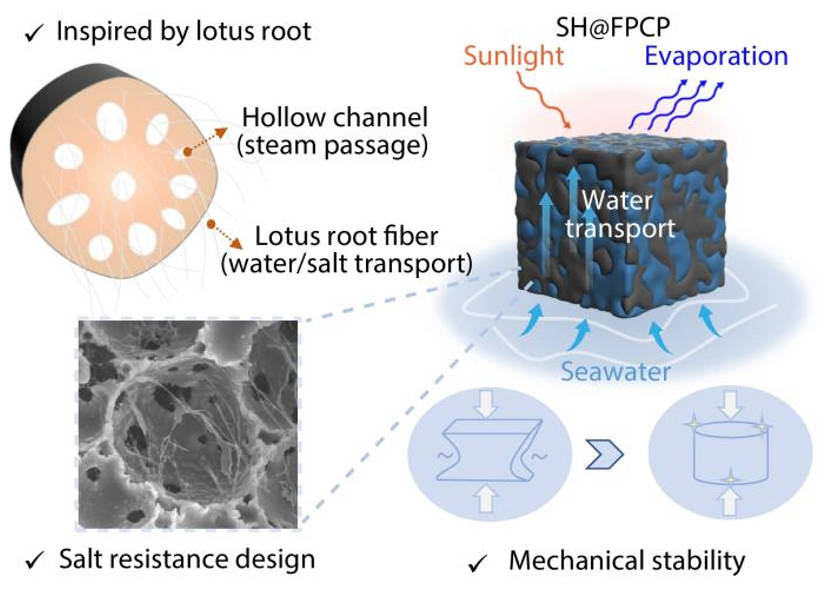
Lotus-root-inspired solar evaporator for salt-resistant desalination.
GA, UNITED STATES, June 10, 2026 /EINPresswire.com/ -- Freshwater scarcity is driving demand for desalination technologies that are efficient, low-cost, and reliable beyond the laboratory. A new lotus-root-inspired solar evaporator offers a promising solution by combining rapid water transport, salt resistance, mechanical robustness, and heat-to-electricity conversion in one material platform. The system integrates a polymerized high internal phase emulsion (PolyHIPE) scaffold with a sulfonic hydrogel (SH) network, creating open pathways for vapor escape while continuously supplying water and redistributing salts. Under one-sun irradiation, the evaporator produced freshwater at a high rate and also harvested low-grade heat through a thermoelectric (TE) module, showing potential for integrated water–energy systems.
Solar-driven interfacial evaporation has emerged as a sustainable approach to desalination because it concentrates solar heat at the water–air interface rather than heating the entire water body. However, several barriers still limit practical use. Salt crystals can accumulate on the evaporation surface, blocking vapor pathways and reducing long-term efficiency. Many hydrogel- or aerogel-based evaporators also lack sufficient mechanical strength, making them vulnerable to deformation or collapse. Meanwhile, the low-grade heat generated during evaporation is often wasted. Based on these challenges, there is a need to conduct in-depth research on integrated evaporator designs that combine salt management, structural durability, and energy recovery.
Researchers from Donghua University, reported the new design in Chinese Journal of Polymer Science. The article was published (DOI: 10.1007/s10118-026-3586-9) online on April 9, 2026. The team developed a biomimetic PolyHIPE/hydrogel composite evaporator for salt-resistant solar desalination and simultaneous power generation.
The material, named SH@FPCP, takes functional inspiration from lotus roots, whose hollow channels support gas exchange while fibrous tissues guide water movement. In SH@FPCP, the interconnected macroporous PolyHIPE framework works like vapor channels, helping steam leave quickly during evaporation. Hydrogel filaments threaded through the pores act as water and salt-transport pathways, continuously replenishing water and helping dissolve accumulating salts. A fluorinated polypyrrole (FPPy)-modified framework provides strong photothermal response under sunlight. This combined architecture delivered an evaporation rate of 3.19 kg m−2 h−1 under one-sun irradiation, while maintaining stable salt-resistant operation for more than one week. It also performed steadily in sodium chloride (NaCl) solutions from 3.5 wt% to 20.0 wt%. Mechanical testing showed a compressive strength of 1298 kPa at 5% strain, demonstrating that the rigid porous scaffold effectively reinforces the softer hydrogel network.
The authors said the study shows how a biological structure can guide the design of more practical solar desalination materials. They said the key advance is not a single function, but the way several functions are built into one architecture: open pores speed vapor release, hydrogel pathways sustain water supply, sulfonic groups assist salt management, and the photothermal framework converts sunlight into heat. They also said this integrated strategy helps address problems that often appear together in real desalination settings, including salt buildup, weak mechanical stability, and wasted thermal energy.
The system also makes use of heat that would otherwise be lost during evaporation. When SH@FPCP was coupled with a thermoelectric (TE) module, the temperature difference between the hot photothermal surface and the cooler water-contacting side generated electricity through the Seebeck effect. Under one-sun irradiation in a wet state, the device achieved a power density of 720 mW m−2, an open-circuit voltage (Voc) of 110 mV, and a short-circuit current (Isc) of 10.4 mA. Even during power generation, the evaporator maintained a high evaporation rate of 3.05 kg m−2 h−1. Outdoor testing further showed that the condensed water met World Health Organization (WHO) drinking-water standards.
This biomimetic evaporator points toward durable, multifunctional solar desalination systems for water-stressed, coastal, and off-grid regions. Its value lies in producing freshwater while improving the overall use of solar-derived heat. The platform may also support wastewater purification, as the study showed removal of organic dyes including methylene blue (MB) and methyl orange (MO). With further scale-up, device optimization, and field validation, PolyHIPE/hydrogel evaporators could become part of decentralized water-treatment technologies that are lightweight, salt-resistant, mechanically robust, and capable of generating small but useful amounts of electricity.
DOI
10.1007/s10118-026-3586-9
Original Source URL
https://doi.org/10.1007/s10118-026-3586-9
Funding information
This work was financially supported by the National Natural Science Foundation of China (Nos. 52373172 and 52473055), the National Key Research and Development Program of China (Nos. 2022YFB3807100 and 2022YFB3807102), the Chang Jiang Scholar Program (No. T2023082), the Shanghai Science and Technology Plan Project (No. 25DX1400200), the Natural Science Foundation of Shanghai (No. 23ZR1401100) and the Key Technology Research and Development Program of Shanghai (No. 25CL2900800).
Lucy Wang
BioDesign Research
email us here
Legal Disclaimer:
EIN Presswire provides this news content "as is" without warranty of any kind. We do not accept any responsibility or liability for the accuracy, content, images, videos, licenses, completeness, legality, or reliability of the information contained in this article. If you have any complaints or copyright issues related to this article, kindly contact the author above.
